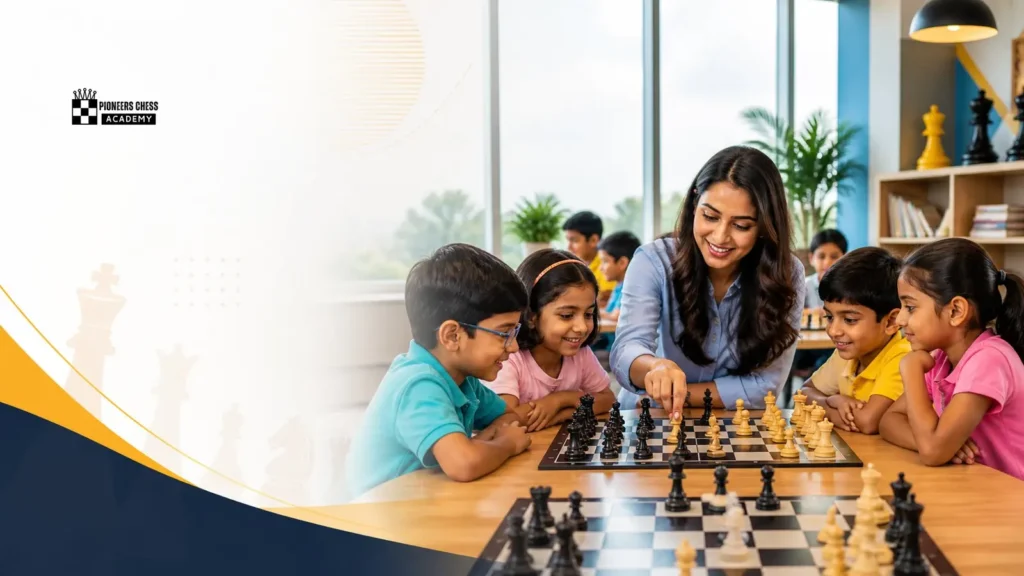
When most people think of chess, they picture a quiet game played by adults in dim-lit rooms. But here at Pioneers Chess Academy, we see something very different every single day we see children laughing, thinking, and growing, one move at a time.
Chess is not just a board game. It is one of the most powerful developmental tools available to children today. From building sharper thinking skills to boosting confidence and emotional resilience, the benefits of chess for kids go far beyond the 64 squares on the board.
Founded by FIDE-rated coach and MBA graduate Praneeta Lahoti, Pioneers Chess Academy has been transforming young minds through expert chess coaching across Kalaburagi, Bangalore, Hyderabad, and Online. In this blog, we explore the top 10 science-backed and experience-driven benefits of chess for children.
Top 10 Benefits of Chess for Kids
1. Sharpens Critical Thinking and Problem-Solving Skills
Every single move in a chess game demands a decision. Children must evaluate multiple options, think about what could go wrong, and choose the best path forward. This constant exercise in decision-making directly strengthens critical thinking skills that are highly valuable in academics and in everyday life.
Chess teaches children to think before they act. It builds the habit of logical analysis, reduces impulsive behaviour, and helps kids understand that every action has a consequence. These are skills that will serve them well long after they leave the chessboard.
2. Boosts Memory and Concentration
Remembering opening patterns, tracking opponent strategies, and visualising future positions all exercise a child’s working memory in a powerful way. Multiple studies show that students who play chess regularly demonstrate stronger recall, better retention of classroom material, and longer attention spans.
Even short, regular chess sessions can significantly improve a child’s ability to concentrate for extended periods. In a world full of digital distractions, chess is one of the few activities that trains deep, sustained focus in a way children actually enjoy.
3. Develops Strategic and Long-Term Thinking
Chess is a masterclass in planning ahead. Children learn very quickly that what they do now will have consequences several moves down the road. This fosters goal-oriented thinking, teaches delayed gratification, and builds the ability to construct and execute long-term strategies.
Whether planning for an exam, a sports match, or a career, the ability to think strategically is an enormous life advantage. Chess builds this instinct naturally and enjoyably from a young age.
4. Improves Maths and Academic Performance
Chess is deeply rooted in pattern recognition, spatial reasoning, and mathematical thinking. Research published in the Journal of Educational Research found that children who play chess score significantly higher in mathematics compared to non-players.
The logical structures and numerical thinking developed through chess directly support STEM subjects in school. Many parents at Pioneers Chess Academy have reported noticeable improvements in their children’s maths and science grades after just a few months of regular chess training.
5. Builds Patience and Emotional Regulation
Losing a game is part of chess. And learning how to lose gracefully, without anger or frustration, is one of the game’s greatest life lessons. Children who play chess regularly develop resilience, learn to manage difficult emotions, and discover how to stay calm and composed under pressure.
This emotional intelligence is increasingly recognised as a cornerstone of mental health, healthy relationships, and long-term success. Chess does not just teach children how to win; it teaches them how to handle losing with dignity and bounce back stronger.
6. Enhances Creativity and Imagination
Contrary to popular belief, chess is a deeply creative game. Crafting a surprise attack, devising an unexpected defence, and finding a brilliant combination that no one saw coming all require genuine imagination and creative thinking.
Kids learn that the most powerful solutions are often unconventional. This “think outside the box” mindset is invaluable in art, writing, entrepreneurship, engineering, and virtually every field they may choose to pursue in life.
7. Builds Self-Confidence and Independence
In chess, every decision is yours and yours alone. There is no team to lean on, no one to pass the responsibility to. Over time, children grow deeply comfortable trusting their own judgment and standing by their decisions. Winning a game after careful analysis or recovering from a difficult position to turn things around builds genuine, earned confidence.
At Pioneers Chess Academy, we have seen some of the shyest, most hesitant children transform into bold, self-assured thinkers through regular play, coaching, and competition. Chess gives every child a space to prove themselves.
8. Teaches Sportsmanship and Social Skills
Chess is played across all cultures, languages, and social backgrounds. Children learn to respect their opponents, shake hands after a match regardless of the outcome, and appreciate a well-played game even when they are on the losing side.
Tournament experiences teach kids to handle competitive pressure, interact respectfully with strangers, and be part of a welcoming global community. These social skills, rooted in mutual respect and fair play, are essential for life in every setting.
9. Exercises Both Brain Hemispheres Simultaneously
Neuroimaging research shows that chess activates both the left brain, responsible for logic and analysis, and the right brain, responsible for creativity and pattern recognition, at the same time. This dual-brain engagement strengthens neural pathways and contributes to higher overall cognitive development.
Think of chess as a complete gym workout for your child’s brain. Just as physical exercise develops the body, regular chess develops the mind in a holistic and lasting way.
10. Instils a Love for Lifelong Learning
There is always something new to learn in chess. A new opening system, a clever tactical motif, a grandmaster game to study, a tournament to prepare for. This culture of continuous improvement teaches children to embrace learning as a lifelong journey rather than a destination with a fixed finish line.
Children who develop this mindset become better students, more curious professionals, and more thoughtful human beings. It is perhaps the most enduring gift that chess gives to every child who steps onto the board.
Give Your Child the Chess Advantage
At Pioneers Chess Academy, we offer structured, fun, and highly effective chess classes for kids at all levels. From absolute beginners to competitive players, our programs are designed to bring out the best in every child.
We offer:
- Online Chess Classes – learn from anywhere in India
- Chess Classes in Bangalore
- Chess Classes in Hyderabad
- Chess Classes in Gulbarga
- Dedicated Chess Classes for Kids aged 5 and above
Enroll today and let your child discover the power of the chessboard. Visit us at pioneerschessacademy.in or fill in our enrollment form to book a free trial class.
Frequently Asked Questions (FAQs)
Why is chess important for children?
Chess is important for children because it develops cognitive, emotional, and social skills all in one engaging activity. Unlike passive entertainment, chess demands active thinking. Children must plan, adapt, and make independent decisions. It improves academic performance especially in maths and reading, builds resilience through wins and losses, and instils discipline, patience, and focus. Chess is one of the few activities that delivers measurable mental development while remaining genuinely enjoyable for children.
Why are kids so good at chess?
Children’s brains are highly plastic, meaning they absorb patterns, rules, and strategies at a speed that adults simply cannot match. Young learners have little fear of failure, which encourages them to experiment and learn rapidly. Children are also at their peak for memorisation and pattern recognition, the two core abilities that underpin chess mastery. With the right coaching environment, children can progress from beginner to competitive player in a matter of months.
Does chess increase IQ in kids?
Multiple studies, including a landmark Venezuelan study involving over 4,000 students, found significant increases in IQ scores among children who received chess instruction. While chess alone may not be the only factor, it exercises the specific mental abilities that IQ tests measure: pattern recognition, spatial reasoning, working memory, and logical deduction. Regular, structured chess training produces measurable cognitive gains in children, particularly in the 5 to 14 age group.
Is chess good for the brain?
Absolutely. Chess is widely regarded as one of the most comprehensive brain exercises available. It activates both hemispheres of the brain simultaneously, improves neuroplasticity, strengthens problem-solving circuits, and has even been linked to delayed cognitive decline in older adults. For children, regular chess play strengthens neural pathways associated with concentration, memory, planning, and creative thinking. Playing chess is genuinely like going to the gym, but for the mind.
Are chess kids smart?
Rather than saying chess kids are naturally smart, it is far more accurate to say that chess makes kids smarter. Research consistently shows that children who play chess outperform peers in academic assessments, demonstrate stronger problem-solving abilities, and exhibit better emotional regulation. The discipline, focus, and analytical thinking developed through chess give these children a real advantage in the classroom, in exams, and in life. At Pioneers Chess Academy, we have seen ordinary children achieve extraordinary things through the power of chess.